
You don’t have to pull out your phone to start Googling. I’ve got you covered. If you’ve been comparing infant formula labels, you may have come across four unfamiliar letters: MFGM. This stands for “milk fat globule membrane,” and it sounds like something straight out of a chemistry textbook.
But what is it? And does your baby need it?
Table of Contents
What Exactly Is MFGM?
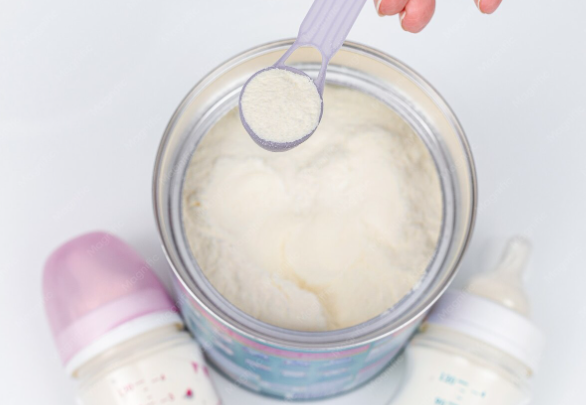
Infant-formula manufacturers include MFGM in their product with the intention of narrowing the gap between the nutrition breast-fed babies receive and that of formula-only babies. Milk fat globule membrane, or MFGM, is actually just a natural membrane that surrounds fat droplets in human breast milk and other mammalian milk. It carries fat, which is a very important source of energy for the rapid growth that is occurring in infants’ brains and other parts of their little bodies.
The easy part is figuring out if the formula you’re looking into has it included. Parents do not need a background in food science to begin comparing products by the label. The tricky part is understanding how it gets there and deciding which form you prefer for your baby because some formulas specifically concentrate and add MFGM or MFGM components during manufacturing, while other formulas made with whole milk already contain the naturally occurring MFGM components from the milk itself.
MFGM: Added vs. Naturally Occurring in Milk Base
One of the most important distinctions parents need to understand is the difference between a formula that receives an additional MFGM-containing ingredient during manufacturing and one that already naturally contains MFGM components because of its dairy-based ingredients.
Although both formulas obtain MFGM components from naturally occurring dairy sources, the way manufacturers handle and describe those sources is an important distinction for you to understand.
For example, Enfamil NeuroPro identifies whey protein concentrate as its source of naturally occurring MFGM components. Whey protein concentrate is produced by separating the liquid whey portion of milk and concentrating its proteins. It is then incorporated into the formula as a separately listed dairy ingredient.
Little Spoon takes a whole-milk-based approach. Its manufacturer identifies organic grass-fed whole milk as the source of naturally occurring MFGM. Whole milk naturally contains milk fat globules and their surrounding membranes, meaning these components are already present within the milk itself rather than requiring a separately identified concentrated MFGM ingredient.
Both products do contain whey protein concentrate as an ingredient. The distinction is not that one uses whey and the other does not. Rather, what is important here is which dairy ingredient the manufacturers identify as the main source of their MFGM and how it is handled before it goes on the shelf at your local grocery store.
Formulas with Specifically Added MFGM Ingredients
Some formulas incorporate an ingredient specifically selected to provide MFGM or a concentrated collection of its components. They do this by extracting and blending cow-derived MFGM into their formula mix. Depending on the brand’s verbiage, this ingredient may be described on the label using terms such as “MFGM,” “milk fat globule membrane components,” or a designated dairy ingredient that supplies MFGM components like “whey protein concentrate.” Check out the partial Enfamil label below as an example:
Enfamil NeuroPro Infant Formula
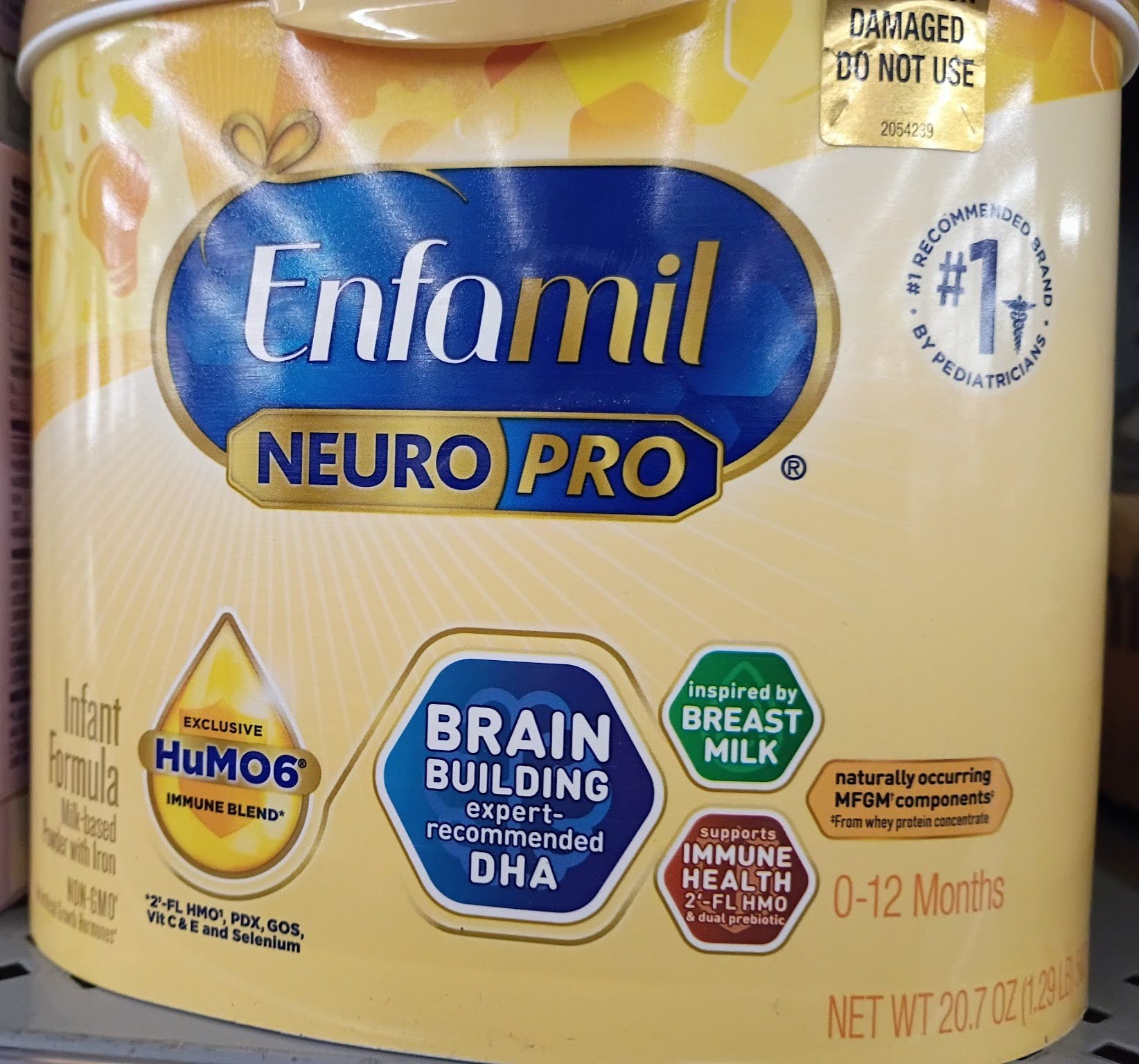
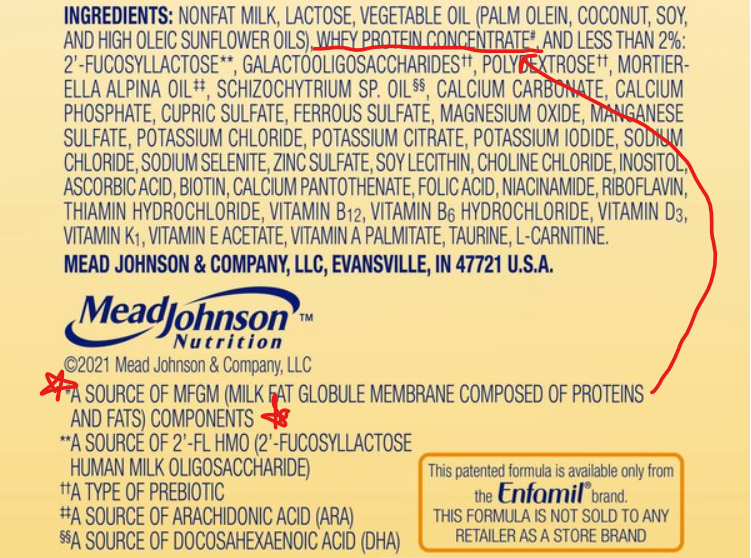
Remember, the ingredient’s source, composition, and concentration can vary between brands, so just seeing the term “MFGM” does not necessarily indicate that every formula contains an identical ingredient or amount per serving.
When a manufacturer specifically advertises MFGM supplementation, parents can look for an explanation of the ingredient source and its role in the product.
A dedicated MFGM ingredient like you see on the Enfamil label above is not the same as simply using whole milk as the primary dairy ingredient, even though both approaches do contribute MFGM to the finished formula.
Enfamil NeuroPro is a good example of a formula that adds their own MFGM components. The manufacturer discusses the separate addition in its product information. On its official product page, Enfamil identifies whey protein concentrate as a source of naturally occurring MFGM components.
You might see a formula brand like this highlight MFGM in its marketing or nutritional panel while providing those components through a different name (like “HuMO6”) rather than listing a standalone ingredient named “MFGM.”
Enfamil has multiple varieties of formula that add MFGM through an alternate source like whey protein concentrate that you might want to check out.
Formulas That Obtain MFGM Components Through Their Milk Base

Whole milk–based formulas offer a more natural way to include milk-derived components like MFGM. Whole milk naturally contains fat globules surrounded by these membranes, so using it as a base for the formula provides a source of naturally occurring MFGM without having to unnecessarily add any extra ultra-processed or concentrated products to your baby’s diet.
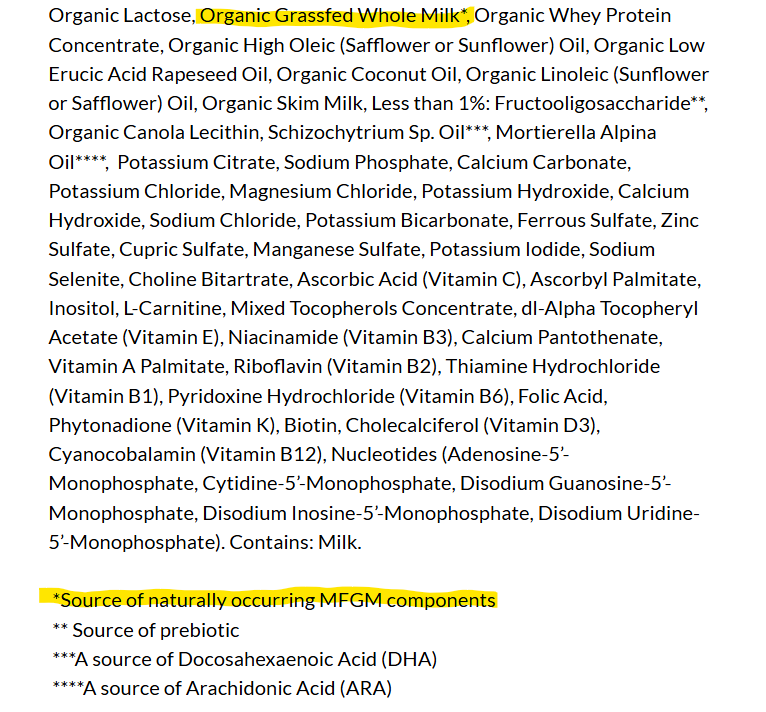
However, remember that the amount and composition of those components in the finished formula depend on the type and quality of milk ingredients used and how the product is manufactured.
Heavy processing may of course alter the original membrane structures, and a whole-milk base does not 100% guarantee and establish that a formula retains all the exact same components, quantities, or structures as human breast milk. It’s simply an attempt to get as close to the benefits of human breast milk as we can.
This is where the MFGM situation gets tricky and is why the wording on a product label really matters. A manufacturer may identify whole milk as a source of naturally occurring MFGM components without listing MFGM as a separate ingredient. You can know it’s in there via the whole milk, but you may not see it listed as a separate ingredient because they did not have to add it separately.
The distinction is especially relevant when comparing products that advertise a specific MFGM addition with products that emphasize whole-milk ingredients. Both may provide MFGM-related components, but the ingredient source and formulation approach are not necessarily interchangeable.
Little Spoon Organic Whole Milk Infant Formula
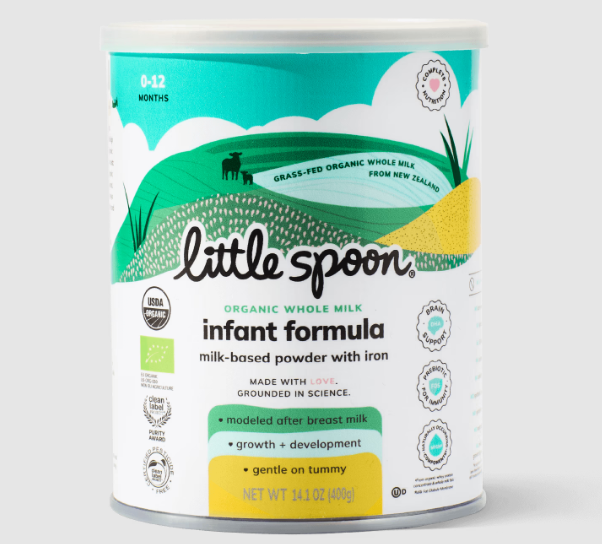
Little Spoon’s Organic Whole Milk Infant Formula uses organic grass-fed whole milk as a primary dairy ingredient, and the ingredient list identifies it as their source of naturally occurring MFGM.
For parents comparing formulas, this is a useful example of why you sometimes need to read ingredient lists alongside the manufacturer’s notes. If you are searching only for the letters “MFGM” among the ingredients, you might overlook the products’ differences in source.
When you’re looking at the ingredient label on any infant formula, if the source of MFGM is a dairy product, you might see it identified in a similar fashion to the Little Spoon label.
So, What Does All of That Really Mean?
The difference is the comparison between:
- An ingredient that is naturally found in milk but extracted, concentrated, and added back into a formula
versus
- A formula that uses whole milk as its dairy foundation and therefore brings along some of the milk’s naturally occurring MFGM components without all the extra processing
Both whey protein concentrate and MFGM are milk derived. Neither is an artificial, manmade substance, but their roles in the formula are different.

Enfamil NeuroPro: Whey protein concentrate is a separately listed dairy ingredient. It is obtained by separating whey from milk and concentrating its proteins. Enfamil identifies it as a source of naturally occurring MFGM components.
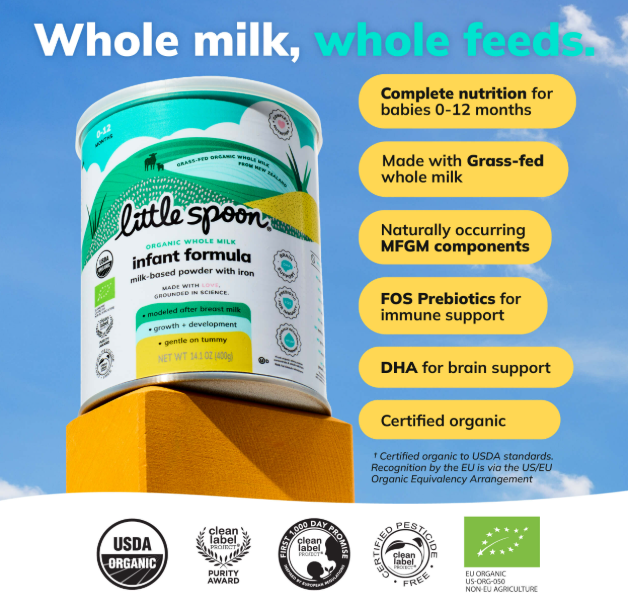
Little Spoon: Whole milk is used as a foundational dairy ingredient. The manufacturer identifies that whole milk as a source of naturally occurring MFGM components. Rather than relying on a separately listed whey protein concentrate as the identified MFGM source, the formula uses a milk ingredient that already naturally contains the MFGM and its components.
The important distinction is not that one ingredient is natural and the other isn’t. Both are natural in origin. It’s how those components are sourced and incorporated into the finished formula.
If This Is All Still a Little Foggy, Think of It Like This
Imagine you’re buying apple juice. One manufacturer separates out a particular part of the apple, processes it, concentrates it, and adds it back into the beverage. Another manufacturer just uses the whole apple as part of its ingredients for the drink.
Both ingredients originate from an apple, but they enter the finished product very differently.
How to Compare Other Brands
Formulas may use MFGM-rich dairy ingredients, concentrated milk fractions, or other specifically identified component sources. Remember their exact formulations can vary by product line, stage, country, and formulation.
For that reason, a brand-wide statement such as “this brand contains MFGM” can be misleading if it is based only on one product. A brand may sell multiple formulas with different ingredient combinations.
A thorough comparison should identify the exact infant formula product, review its current ingredient list and official product explanation, and state whether MFGM is specifically added or whether the manufacturer identifies a dairy ingredient as a source of naturally occurring MFGM components.
If a manufacturer does not clearly disclose the source or amount at all, take note of that, too.
So, What Does the Research Say About MFGM?
Interest in MFGM is supported by a growing body of research, but the evidence ultimately deserves a careful read by you as the parent.
Researchers have investigated whether adding bovine MFGM components to infant formula may influence infant development outcomes like cognitive development, immune function, and the incidence of certain infections. Some clinical studies, like the two below, have reported encouraging findings, including positive differences in selected cognitive measures.
In 2024, a review and analysis published in Nutrients examined eight randomized controlled trials involving 1,352 participants. The researchers reported an association between MFGM-supplemented formula and higher cognitive scores in the studies they analyzed. They also reported improvements in certain executive-function measures, while finding no statistically significant improvements in language, motor, or social-emotional development in their respective analyses.
However, the authors’ overall discussion acknowledged that the evidence remains limited. The number of studies, specific formulations tested, outcomes measured, and duration of follow-up all affect how confidently these findings can be applied to everyday feeding decisions for you.
This report is a great place to start if you’re looking to deep dive into your own research.
Another earlier review, published in 2021, discussed promising findings as well but ultimately decided the available evidence was insufficient to officially confirm the proposed benefits being evaluated, like cognitive-development gains and infection risk. It’s another good one to check out if you’re into the behind-the-scenes stuff.
If you consider these studies together, their findings do suggest that MFGM is a relevant area of infant nutrition research, not simply the next marketing ploy. However, every MFGM-containing formula isn’t going to produce the same outcome, and a formula containing MFGM components through whole milk ingredients may not deliver the same effects as one with a specifically crafted supplemental MFGM additive.
That distinction does matter because clinical research takes a deeper look into particular formulations, ingredient sources, quantities, and feeding conditions. Logically, it follows that a result observed with one preparation cannot automatically be transferred to every formula that contains some MFGM components.
As a parent, you should also be cautious about any claims that MFGM guarantees higher intelligence, superior brain development, stronger immunity, or outcomes equivalent to breastfeeding. The research does not justify such sweeping blanket statements.
Does Added MFGM Automatically Make One Formula Better?
Not necessarily. This is only one part of a much larger nutritional picture.
A formula containing a separately added MFGM preparation is not automatically entirely superior or inferior to a whole milk–based formula. Make sure that you as a parent do your homework on the rest of the ingredient label as well.
For families, practical considerations also play a role. A formula needs to be appropriate for the infant’s age and nutritional needs, prepared according to its directions, and affordable and accessible enough to be used consistently.
Obviously, parents who are unsure which formula is appropriate for their child can discuss their options with their pediatrician. This can be particularly important if your infant has suspected allergies, growth concerns, or other medical considerations.
The Bottom Line with MFGM
MFGM is a naturally occurring component in mammalian milk that has become an area of interest in infant-formula research. Some formulas specifically add MFGM or MFGM-rich ingredients, while others obtain MFGM components through their natural dairy ingredients, like whole milk.
Little Spoon’s Organic Whole Milk Infant Formula belongs in the latter category, according to its current published ingredient information, which identifies organic grass-fed whole milk as a source of naturally occurring MFGM components. Contrarily, Enfamil NeuroPro’s product information identifies their source of MFGM components as a whey protein concentrate additive.
The research into MFGM has produced promising findings, particularly in cognitive development, but important questions remain about the consistency and long-term significance of those findings.
For you as a parent, the most useful approach is to look beyond a single buzzword. Read the full label, verify the manufacturer’s explanation, distinguish between added ingredients and naturally occurring components, and interpret developmental claims in light of the actual evidence.
Understanding these differences makes it much easier to compare formulas thoughtfully without assuming one ingredient tells the whole story.