
So you’ve been doing your research, and you’ve crossed a lot of formulas off the list. Now you’re down to two: Nara Organics and Kendamil. Honestly, that’s still a tough call, because neither one is a bad choice.
At first glance, the two formulas can seem very similar. Both are positioned as premium options with European ties, but once you look closer at how each formula is designed, from milk fat composition to nutrient balance, the differences become more meaningful.
In this comparison, we’ll look at ingredients, nutritional profiles, sourcing practices, and unique features in a clear, practical way so you can decide what matters most for your baby.
Table of Contents
Milk Fat Composition: Whole Milk vs. Whole + Skim Blend
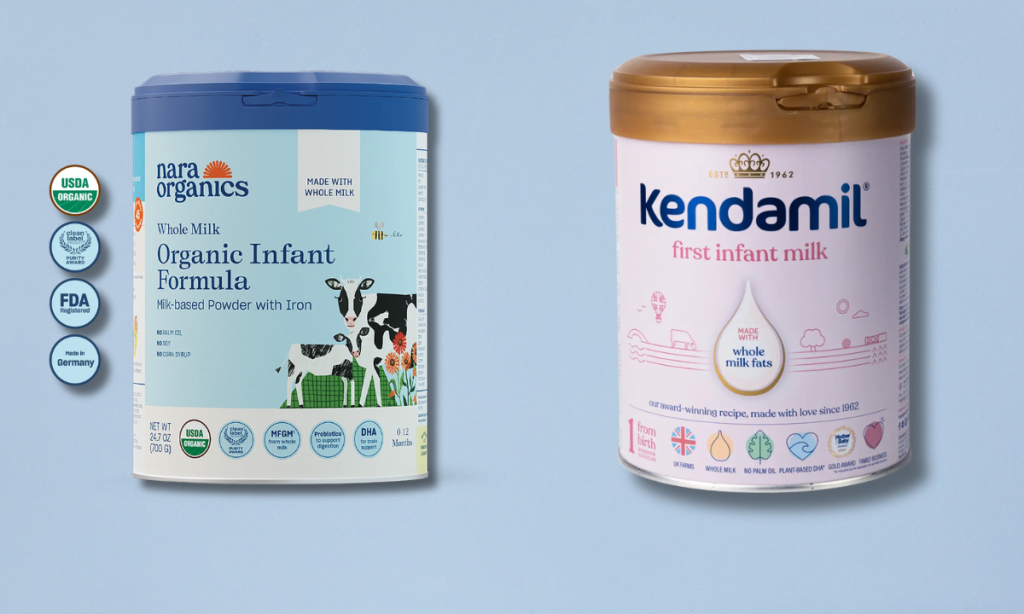
Nara Organics uses whole milk, with no skim milk added. Kendamil also uses whole milk, but its formula includes skim milk as part of the overall blend.
This difference is important because whole milk retains natural milk fat, which is more similar to the natural fat found in breastmilk. Whole milk also supplies palmitic acid in a way that infants can usually digest more easily. Palmitic acid is a type of fat that plays an important role in infant growth and is naturally present in breastmilk.
Skim milk has been used safely in infant formula for decades and provides important nutrients like protein and calcium. However, because it does not contain natural milk fat, formulas that use skim milk often rely more heavily on added vegetable oils to provide the fatty acids, calories, and overall fat balance infants need. Some research suggests that milk fat may be digested differently than vegetable oil-based fats, particularly due to its structure.
For parents comparing the two, the takeaway is simple: Nara starts with a higher amount of natural milk fat and adjusts the balance as needed.In contrast, Kendamil adopts a more conventional formulation method, blending various milk sources.
DHA and ARA: Differences in Brain-Focused Nutrients

Both formulas contain DHA, an omega-3 fatty acid essential for brain and eye development which supports cognitive growth and visual acuity in infants. DHA (docosahexaenoic acid) and ARA (arachidonic acid) are important fatty acids found in breastmilk and infant formulas.
The primary distinction lies in the proportion of DHA to ARA. Nara Organics offers DHA at 20 mg per 100 kcal and ARA at 30 mg per 100 kcal, establishing a ratio that closely reflects typical breastmilk composition. Kendamil also includes DHA at 20 mg per 100 kcal, but provides ARA at 10 mg per 100 kcal, which is lower than both Nara Organics and typical breastmilk composition.
ARA plays an important role in brain development, immune response, and cellular growth. Because DHA and ARA are both naturally present in breast milk at specific ratios, some research suggests that achieving an appropriate balance between the two, rather than focusing exclusively on DHA, may better reflect the nutrient profile naturally available to infants.
For parents comparing the two, the key difference is that Nara prioritizes replicating the natural balance found in breast milk, while Kendamil includes both nutrients at levels that meet formula requirements but with a lower amount of ARA.
Manufacturing and Regulatory Approach: Similar Regions, Different Models

Both formulas are made in Europe but differ slightly in approach. Nara Organics, a U.S.registered formula produced in Germany, meets both EU and FDA standards and was developed through a multi-year research process.
Kendamil, manufactured in the UK, also follows European standards and is known for its long-standing reputation and traditional production.
For parents comparing the two, the key distinction is that both formulas meet strict safety standards, but Nara is a U.S.-registered formula produced in Germany, while Kendamil is an established European formula manufactured in the UK.
Availability and Stock Reliability: A Real-World Consideration
An often overlooked factor in product comparisons is availability. Kendamil can be found easily at major retailers like Target, making it convenient for in-store purchases; however, it sometimes faces stock shortages and has recently experienced formula supply issues.
In contrast, Nara Organics is shipped directly from U.S. distribution centers, which helps ensure a steadier supply since it doesn’t depend on retail inventory cycles.
For parents comparing the two, Kendamil may be easier to pick up in stores when it’s available, while Nara’s direct-shipping model may offer more consistency outside of retail inventory cycles.
Price: Slight Difference, Different Priorities
Kendamil usually costs slightly less, around $40 per can, while Nara Organics is a bit more expensive. Though the price gap isn’t large, formula costs add up over time, especially for families who rely on formula as a primary source of nutrition.
For families watching formula costs closely, Kendamil’s lower price may be an important advantage. Nara Organics may still fall within a similar premium price range, but its higher cost is worth factoring into the monthly budget, especially for parents weighing whether its differences in milk fat, prebiotics, and nutrient balance justify the added expense.
How to Choose Between Nara Organics and Kendamil
Both formulas are excellent options, and neither can be considered a “wrong” choice. In the end, it comes down to what matters most to you.
If you’re seeking a formula made entirely from whole milk, enriched with prebiotics for digestive health, and formulated to closely match the nutrient profile of breastmilk, especially regarding DHA and ARA content, Nara Organics might suit your needs best.
On the other hand, Kendamil could be ideal if you want a reputable European brand that tends to be more affordable and is often easier to find on store shelves when available.
Final Thoughts
At first glance, Nara Organics and Kendamil appear quite similar; both are premium formulas produced in Europe with carefully selected ingredients.
However, a closer examination reveals distinct differences in their formulations. Kendamil adheres to a more traditional formula structure, supported by a strong reputation and competitive pricing.
In contrast, Nara Organics adopts a specialized approach, placing emphasis on whole milk fat, prebiotics, and nutrient ratios designed to more closely resemble those found in breastmilk.
For parents conducting a comparative assessment, the decision typically hinges on individual priorities, whether they value cost efficiency and brand familiarity, or prefer a formula intentionally crafted for specific nutritional alignment.
Ultimately, understanding these distinctions empowers families to make informed and confident choices.