
If your kid is in that early toddler phase, they’re probably rapidly growing through the different stages of foods. This might mean they are ready to move on from purées or earlier food stages. While the experience can be exciting, it can also cause some tension with trying to decide which food options are best for your kid.
Whether you’re trying to decide if you’re going to make all of their food from scratch or throw in some pre-made meals from your favorite subscription service, deciding on food that works for your family can be time-consuming and sometimes even mentally draining.
So, I’m going to give you a head-to-head comparison of two subscription services that are built for this stage of eating. I’ll discuss everything from the menu to ordering and serving to help you land on what fits best into your feeding plans.
Table of Contents
Age and Stage
You may be wondering if your toddler is ready for more of a solid food or if they even meet the age recommendations for Little Spoon Plates or Tiny Organics meals.
Little Spoon Plates are designed for finger-food eaters of ages 2–7. The Plates offer more solid food options that lean more heavily on finger foods and start to get away from small, bite-sized pieces. From my own personal experience, I would agree that being more experienced in finger foods is definitely important before serving the Plates to your kids. Because the plates don’t focus on small, bite-sized pieces like your kids might be used to, some kids might need more practice with larger bites and firmer textures before trying these. Even though some of the full-sized items are soft enough for kids with little or no teeth (e.g., tater tots and pastas), I found that my kids needed some practice with taking smaller bites and not just shoving the entire thing into their mouth at once.
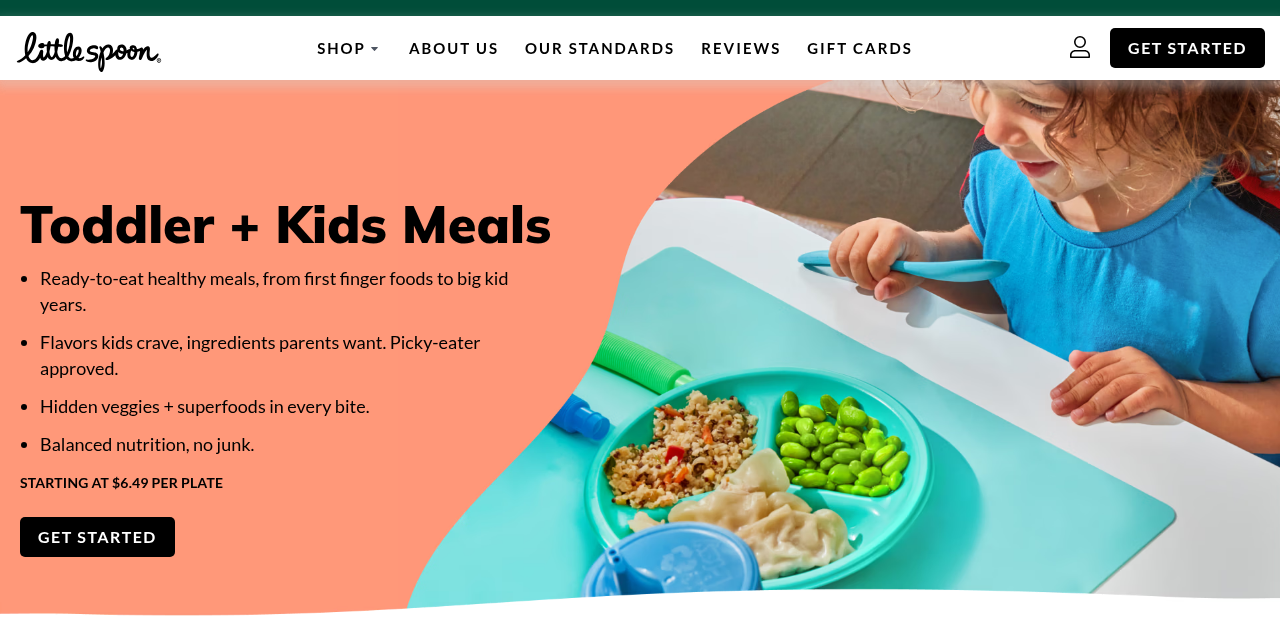
But on the opposite end, just because Little Spoon Plates don’t have small, bite-sized pieces doesn’t mean you should avoid them all together if your child is under 2. Some kids develop teeth and feeding skills earlier than others, which is why it’s important to follow readiness cues when making any decision about food for your baby or toddler. My kids didn’t get teeth until almost 16 months, so they had some catching up to do, but don’t underestimate the strength of those little gums. While they couldn’t eat all of the meals in the Plates line, they still enjoyed plenty of things like mac and cheese, cauliflower croquettes, and ravioli that I cut into smaller pieces for them.
Tiny Organics focuses on meals for kids who are 6+ months old wanting to try textured finger foods. The foods are pre-cut or chopped into smaller pieces and mixed together to create a more textured experience, designed to offer multiple flavors and textures in the same bite as opposed to having kids experience one thing at a time.
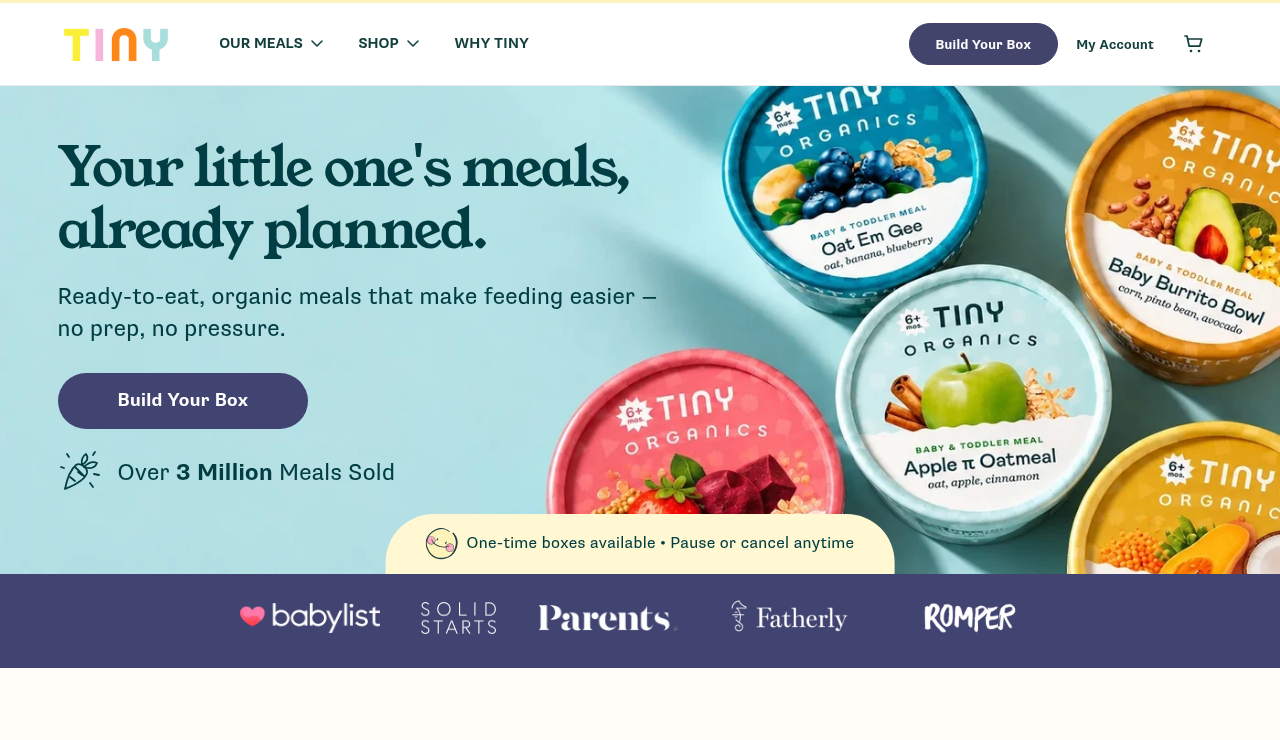
These smaller pieces allow you to start offering these meals to your child at the young 6-month age, potentially right after transitioning from purées. This also means you can skip the process of cutting up any foods you think your kid isn’t ready for yet. That said, Tiny Organics does specify that your child needs to show the important readiness signs like sitting unassisted, demonstrating complete head and neck control, and having an interest in bringing food to their mouth. I highly recommend checking out the CDC readiness signs if you need a source of truth to review when it comes to feeding specifics for your kids.
Menu Philosophy
Both Little Spoon and Tiny Organics position themselves as a step up from typical kids’ meals, but they achieve this in different ways.
Tiny Organics describes its meals as 100% organic, plant-based, and free of the Big-8 allergens, with a focus on introducing babies and toddlers to many flavors and textures early. Little Spoon says Plates are made fresh and packed with veggies, with no preservatives, additives, or fillers, and that every Plate has fewer than 500 mg of salt. Its menu also includes vegan, gluten-free, dairy-free, and vegetarian options, and Plates are nut free with the exception of coconut.
The clear difference here is that Tiny Organics applies one consistent philosophy to every meal, while Little Spoon offers more variety and lets you choose what better fits your family’s priorities and preferences.
Meal Formats and Delivery
Both brands ship their meals in temperature-controlled boxes, allowing for food to be delivered right to your doorstep. But their portions and meal formats are what set them apart the most and might be two of the bigger factors in helping you make a choice.
Tiny Organics meals come in 4.1- to 8-ounce cartons on dry ice that should go straight into the freezer once you get them. They offer multiple flavors, sizes, and textures all mixed into one meal, and when I say mixed, I truly mean mixed. An easy comparison would be a kid version of a one-pan meal, where all ingredients are cooked together before eating instead of dividing on the plate. Parents can choose between a wide range of meal and flavor options, from zucchini pesto pasta to apple pie oatmeal. All meals are peanut free and don’t contain milk, eggs, fish, shellfish, tree nuts, or soybeans, making them a great option if you need to bring these meals on the go or are trying to limit exposure to certain ingredients. They do use coconut and wheat in some of their recipes, though, but it’s always labeled on each container, so you can check it out before purchasing.
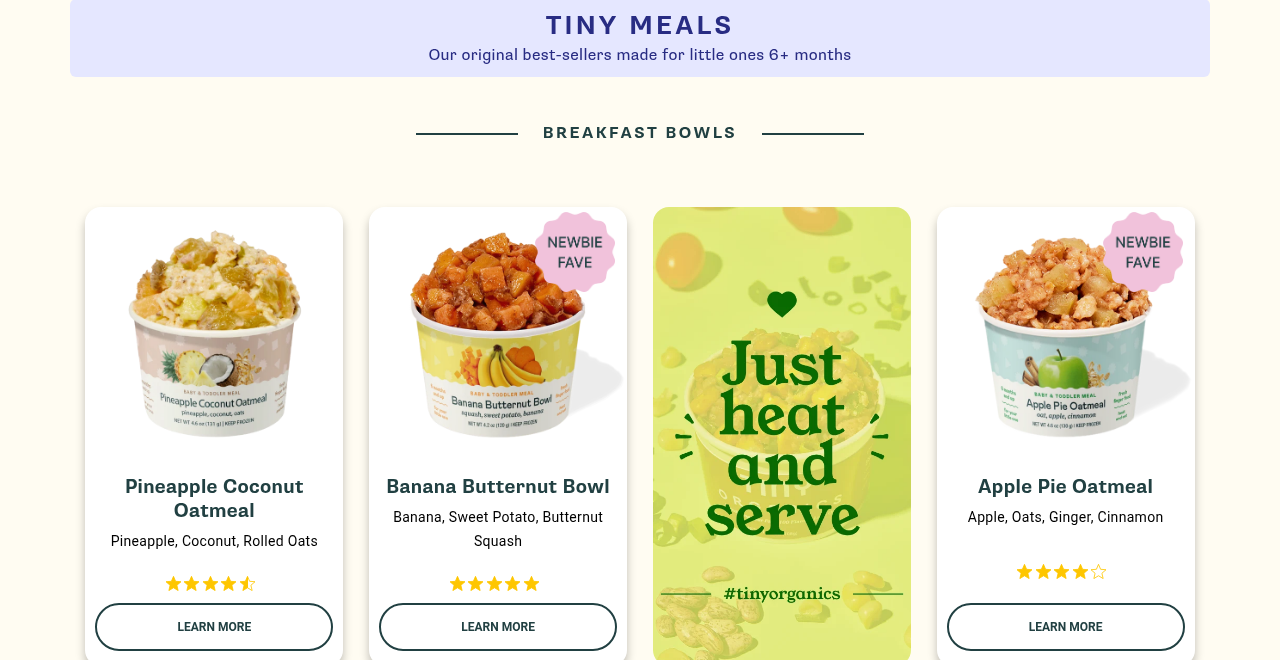
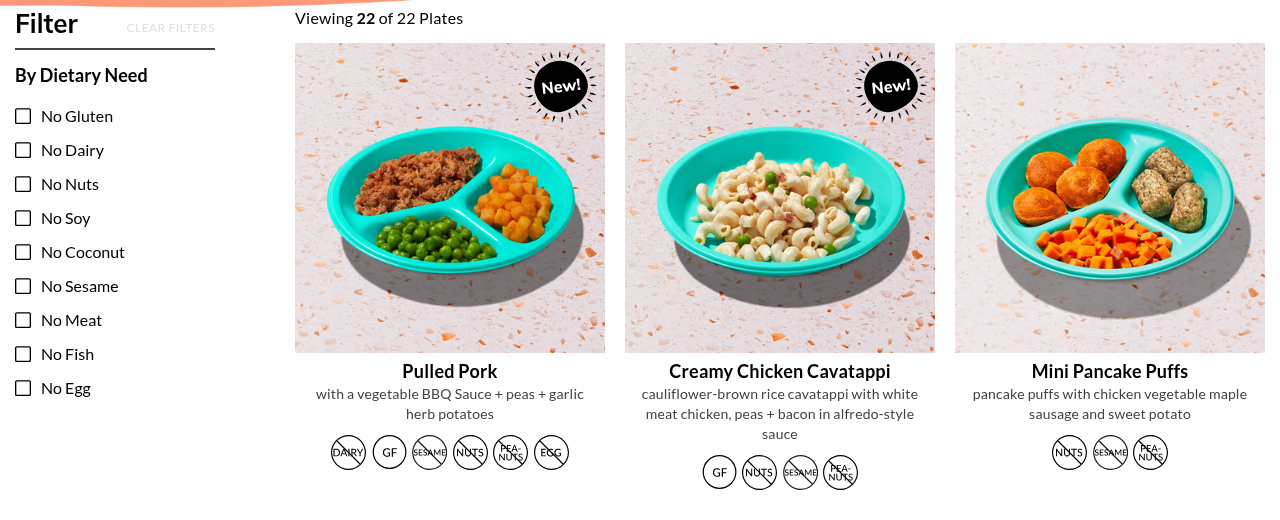
Little Spoon Plates offer what I would consider a more traditional approach to meal time. The Plates serve a variety of foods separated in three different compartments, instead of being mixed together. They also offer more whole-sized foods for more experienced solid-food eaters, instead of being chopped up for those just getting started. Think whole green beans instead of chopped, whole chicken nuggets instead of diced, and sauces staying separate from other foods on the plate. The meals also take a creative approach to more familiar foods, like offering sweet potato tater tots instead of regular ones and different grains like millet mixed with other common flavors to boost benefits for picky eaters. They can be stored in the fridge for seven days or freezer for two months and are designed on seven-inch flat plates for easy stacking.
Cooking and Serving
The ease of cooking and serving is not the only important feature to some parents; the method by which things are cooked can also be high on the list.
Little Spoon Plates come packaged on a BPA-free plate with a film overtop to help with reheating. Plates are placed in the microwave for under two minutes and steamed to reheat the food. The steaming is achieved from the film, which expands to create a small steam dome over the food and allows for even and efficient reheating. Once the meal is heated, the film is removed and the food can be served right on the plate.
Microwave heating is also an option for Tiny Organics along with stovetop heating. Because the food is all in one container and already mixed together, stovetop heating is a great choice to ensure even heating. If you want to use the microwave, you could use your own bowl if you don’t want to heat in the container they provide, even though it’s perfectly safe, but spreading out the food in a bigger bowl may help with more even reheating. Regardless, though, the container all meals come in is safe for heating and eating, so there’s no need to dirty any dishes when serving them if you don’t want to.
I’ve tried both of these products, and when using the microwave to heat both, Little Spoon heats much faster than Tiny Organics. Tiny Organics recommends heating in 30-second intervals until warmed through, but I found it hard to figure out if it was warmed all the way through because the food is mixed together in one container. The Little Spoon Plates were clearly heated thoroughly after following their microwave instructions.
Pricing and Ordering
Subscription models can come with different pricing structures than typical grab-and-go meal options.
Tiny Organics offers three different subscription sizes/options, so you can decide which works best for your growing kids. They offer 12-, 24- or 30+-meal options, which start at $7.49 per meal. The 24- and 30+-meal packages offer free shipping, while shipping for the 12-meal option is $9.99. You can choose from pre-made bundles or pick your own meals if you want a more customized approach. The cost difference in the pick-your-own or pre-selected bundle of 12 is only about $5, with the personalized bundle being the slightly cheaper one.
Little Spoon Plates start at $6.49 per meal, with the costs typically being higher for smaller order sizes. Subscribers can choose from delivery sizes of eight, 12, 18, or 24 meals per delivery, with the 24-meal option bringing the price per meal down to $5.19. You can select from any of the Plate options to allow for customization. Shipping costs $9.99, bringing the total for a delivery of 12 meals to ~$97.
Both companies offer incentives on your first order that can reduce the price, so make sure you check and see what they’re offering at the time you’re looking to purchase. You can pause, skip, or cancel subscriptions at any time for no added fees, which is a nice feature to feel like you aren’t locked in to making an order every single month.
Menu Growth
Obviously, your kids won’t be the same age forever, and they will eventually want to try new foods and textures. Menu growth can be important to consider when choosing a subscription service because you want to make sure it’s something you can commit to long term—not something your kids will grow out of faster than their clothes you’re constantly buying.
Both Little Spoon and Tiny Organics offer room for growth within their feeding model. Tiny Organics looks at growth based on portion size. Their standard meal is around 4.6 ounces (a few are smaller), but they offer an 8-ounce portion size for toddlers who have a bigger appetite and want to eat more of their favorites at the same meal. However, Tiny Organics does not offer different meal choices outside of their finger foods. There are only different sizes.
The Little Spoon Plates don’t come in larger sizes, but they do offer other products that can be used in addition to or in between meals if your child is going through a growth spurt and/or looking for some extra snacks. Their Build and Eat meals are a great choice for lunchboxes that give kids independence in building their own food like pizza. Additionally, they offer frozen items you can heat and serve at home along with other side options of your choice.
If you want to experiment with other food options and are looking for a brand that covers a wider age range, Little Spoon might be worth a closer look.
Final Considerations
Feeding your kids is a super personal experience, and every family has a different approach. While Little Spoon’s separate foods might be important for picky eaters, others might rely on the combined ingredients of Tiny Organics to provide their child with multiple textures and flavors in one bite.
In a world of comparisons, there is truly no one-size-fits-all when it comes to feeding your family. You know your child best, and you may already have an idea of which meal option might serve your family better in the long run. If you’re worried about jumping to one of these more solid food options, always talk with your pediatrician to get clarity on when the right time to start newer food stages might be.