
If you’re stuck trying to decide whether organic infant formula is worth the extra cost, you’re far from alone. Premium organic formulas can cost significantly more than conventional options, which can leave many new parents wondering whether the higher price comes with commensurate benefits.

As a mom and high school science teacher, I always like to look at the data before making decisions. So, I researched some of the leading organic formulas to take a closer look at what really sets them apart. This guide breaks down some of the nuances when it comes to what you’re paying for, from organic sourcing and ingredient choices to testing and transparency, so you can decide for yourself whether those differences make sense for your family’s priorities and budget.
Table of Contents
What Are Organic Ingredients?

Under USDA organic standards, a product labeled USDA Certified Organic must contain at least 95% organic ingredients. Organic agricultural standards restrict the use of certain synthetic pesticides, fertilizers, antibiotics, and other prohibited substances, and organic production also prohibits the use of genetically modified organisms (GMOs).
For organic infant formula, the organic label also reflects how specific agricultural ingredients are produced and handled. Organic farms and facilities must follow USDA requirements and undergo certification and inspection to verify that they meet those standards before they can use the USDA organic label.
It’s important to remember, though, that organic does not mean completely free of pesticides or other contaminants. Instead, it tells you that the ingredients were produced according to specific organic farming and handling standards.
Organic and Premium Labels
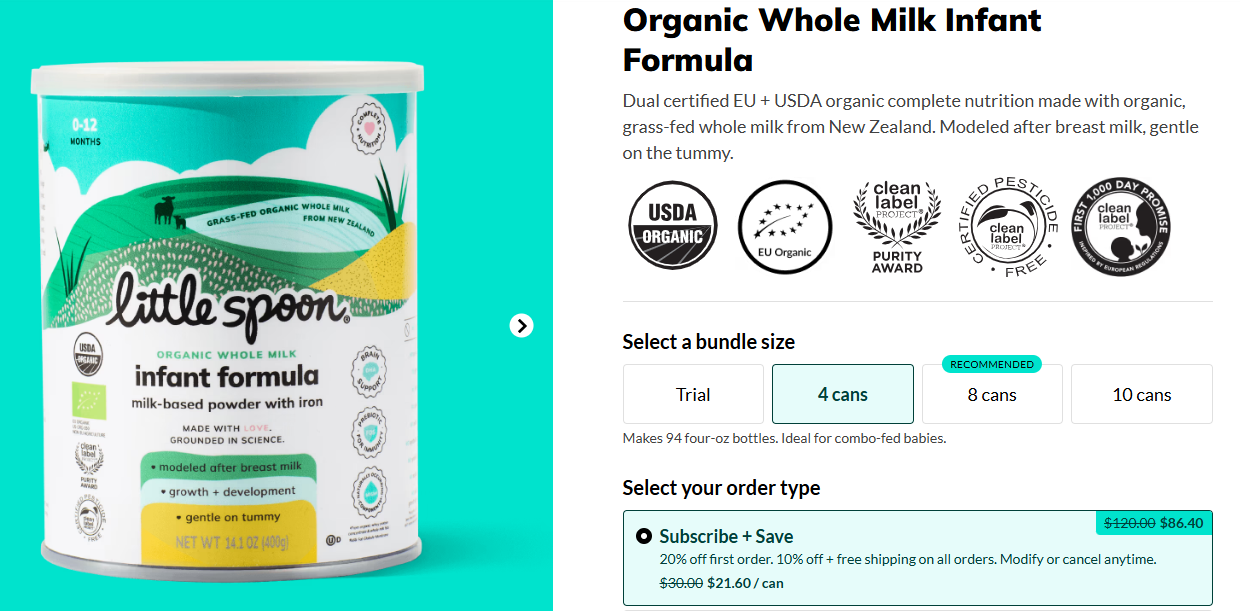
A “premium” baby formula might include specialty ingredients, organic sourcing, or extra nutrients that go beyond baseline federal requirements. But “premium” of course doesn’t mean “the only right choice” and a higher price isn’t automatically worth it for every family.
If your baby is already thriving on a standard formula that meets federal requirements and works for your budget, there’s no need to feel guilty about sticking with it. Organic formula could be worth the extra cost if organic farming practices, ingredient sourcing, testing transparency, and specific nutritional features are non-negotiables. Buying a premium organic infant formula can also be a great choice if you’re seeking a formula that’s made with certified organic ingredients and more stringent sourcing standards.
Additionally, if you’re seeking a whole-milk formula, lactose as the primary carbohydrate, or a recipe without corn syrup solids, palm oil, or maltodextrin, premium organic formulas like Bobbie or Little Spoon might be worth a look. Some organic formulas also come with specific animal-welfare and feeding requirements tied to their organic sourcing standards.
At the end of the day, organic certifications don’t automatically guarantee the formula to be easier to digest or safer for every child. Organic also doesn’t necessarily mean free of all potential allergens or free of every contaminant, either.
Brand Philosophies
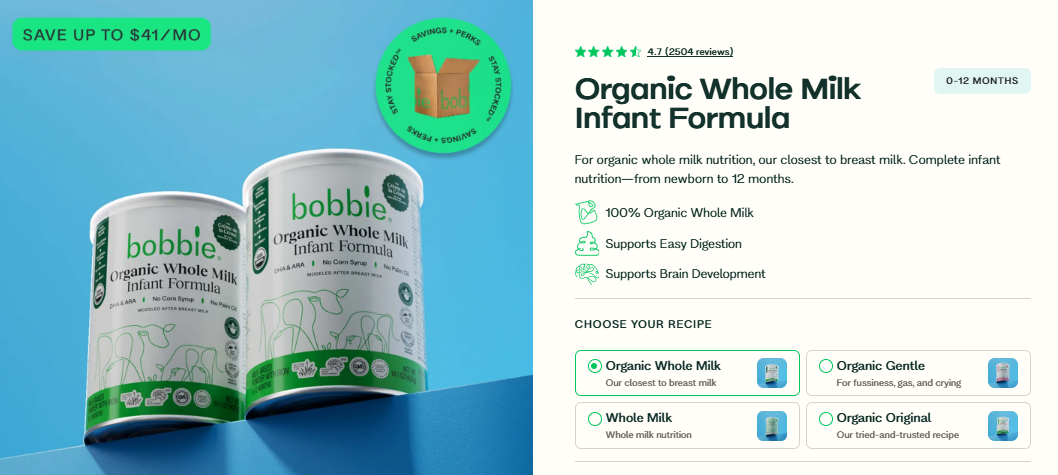
A formula’s ingredient philosophy reflects the principles, priorities, and standards that guide a company’s decisions about what goes into its recipe. While infant formulas sold in the United States must meet FDA requirements for nutritional adequacy and safety, manufacturers have flexibility in the specific ingredients and formulations they use to meet those requirements.
One brand may prioritize pasture-raised, grass-fed dairy as a primary ingredient, while another may focus on a formulation designed to be gentle on digestion. Others may emphasize a recipe intended to more closely resemble the composition of breast milk or choose goat milk instead of cow milk.
These differences can reveal what a company considers to be most important when formulating its product. For instance, a brand might prioritize pasture-raised, grass-fed dairy from a specific region, while another brand may source its milk from a larger network of farms.
Transparency and Third-Party Testing
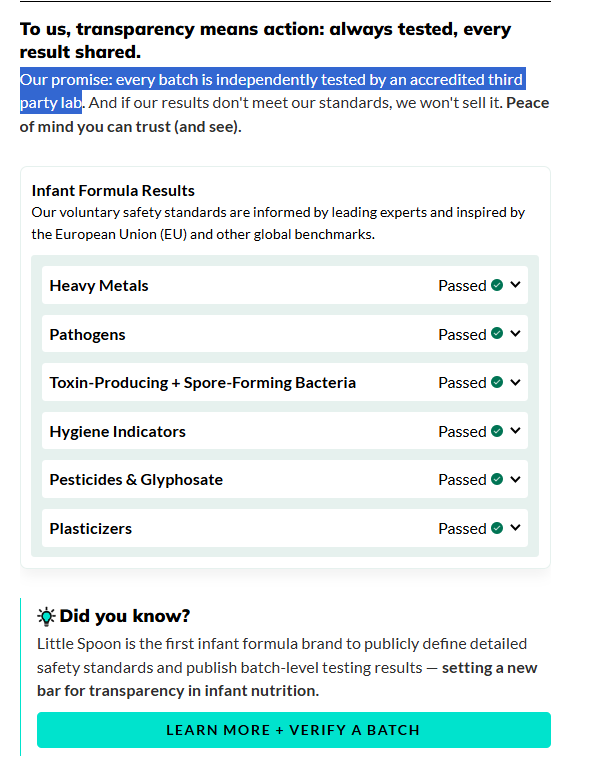
For parents who want to look beyond the ingredient list, information about a brand’s quality-control process can be another factor to consider when comparing formulas.
The brand Little Spoon, for example, provides detailed information about its sourcing, testing, and manufacturing practices. The brand says every batch of its infant formula is tested for 500+ toxins and contaminants across categories that include heavy metals, pathogens, pesticides and glyphosate, plasticizers, hygiene indicators, and toxin-producing or spore-forming bacteria. It also publishes batch-level testing results and its own safety thresholds, allowing parents to look up results for a specific product using its lot code.
That level of transparency can make it easier to understand what testing a formula undergoes and what standards a brand uses to evaluate its products. Other brands may test for many of the same contaminants without making their results or testing thresholds as readily available to consumers.
When comparing formulas, it can therefore be useful to look beyond broad claims like “third-party tested.” Parents can check what substances are tested, how frequently testing occurs, whether results are publicly available, and whether the brand explains the standards used to evaluate those results.
Convenience

For many families, convenience will also be another major consideration that makes a higher-priced formula feel especially worthwhile. Organic formula isn’t equally easy to find in local stores, and availability can vary depending on where you live. If you’re already juggling feedings, diaper changes, and a chaotic schedule, being able to order formula online in minutes and have it delivered without the hassle of a commute can eliminate yet another errand from your already packed routine.
Other families might be interested in buying an organic brand of baby formula but would prefer not to have to order online. In this case, brands like Kendamil or Earth’s Best can be great options. If you prefer an online monthly subscription that arrives right at your door, most brands that offer subscriptions, like Little Spoon, give parents the option to subscribe and receive a discount or just complete one-time orders. Depending on the brand, parents may also be able to adjust, pause, or cancel a subscription, while one-time purchasing may be available for families who don’t want a recurring order.
A Quick Word on Standard Formulas

If your baby is thriving on a standard store-bought formula and your pediatrician is satisfied with their growth, then maybe you don’t need to worry about the extra expense.
If a specific variety of formula is medically necessary for your little one or if you need to buy a certain brand to have that expense covered by WIC or a similar program, please don’t guilt trip yourself. The most expensive formula won’t necessarily be the best choice for every family, and cost should never be a source of guilt if a standard formula meets your baby’s needs.
Digestibility (organic or otherwise) will also depend on each individual baby and each specific formulation. Some babies will do very well on organic formulas, while others may happily thrive on conventional formulas or need more specialized options recommended by a pediatrician.
If the budget doesn’t allow for the extra expense right now, that’s totally ok.
Final Thoughts
So, does a more expensive formula equate to a better formula?
Sometimes, you’re going to be paying for specific ingredient-sourcing practices, greater production transparency, or subscription home delivery convenience, but not necessarily for ‘better’ or ‘more’ nutrition. At the end of the day, infant formulas legally sold in the U.S. must meet FDA requirements for nutritional adequacy and safety, and that applies to store-brand formulas as well as more expensive name-brand options.
If consuming organic food is important to your family and you’re willing to pay more for greater sourcing transparency, organic infant formula brands like Bobbie, Kendamil, Little Spoon, Earth’s Best, HiPP, and Happy Baby may be worth the higher price. If you appreciate additional testing disclosures and the brand’s ingredient philosophy aligns with your values, switching to an organic infant formula deserves real consideration, as long as the added cost fits comfortably within your budget.
Consider value beyond dollar amounts when it comes to choosing formula. A higher price may reflect sourcing practices, testing transparency, or convenience rather than better nutrition. The right choice is the formula that meets your baby’s needs and comfortably works within your family’s budget.