
Exactly four years ago, when I transitioned my first son from breastfeeding to formula at seven months, I remember standing in the Walmart aisle feeling as though I needed a chemistry degree to choose a formula. There were words that I could recognize like “whole milk,” “lactose,” and “iron,” but that was pretty much it. Then there were ingredients such as DHA, oligosaccharides, and nucleotides, each surrounded by language that made these ingredients sound important but didn’t really explain how important they really were.

Now that I’m switching to formula again for my second baby, I’m approaching these labels differently. I still care about the details, but I’m less focused on finding the formula with the longest list of “extras.” I want to know every ingredient’s purpose, what evidence backs it up, and whether its absence should change a parent’s decision.
For example, let’s look at nucleotides. They are naturally found in breast milk and perform essential jobs in the body, and some formulas include them. But does that mean every baby needs a nucleotide-based formula?
Well, based on all the parenting forums and multiple pages of Google results, the honest answer is no, not in the way babies need protein, fat, carbohydrates, vitamins, and minerals. Nucleotides are not required additions to standard infant formula, and the body can produce them on its own, but their inclusion is not completely meaningless marketing. There is a reasonable biological case for adding them, supported with some promising research.
What I came to realize is crucial, though, is actually understanding the difference between “potentially beneficial” and “proven essential.”
Table of Contents
What Are Nucleotides, and Why Are They Important?

When I first saw nucleotides listed as an ingredient, I had absolutely no clue what they were. And I’m sure I’m not the only one.
Nucleotides are small compounds that act as building blocks for DNA and RNA. They’re the genetic materials involved in cell growth, repair, and function. Additionally, they contribute to energy transfer and the production of proteins, fats, and carbohydrates. So, in simpler terms, the body uses nucleotides constantly, especially during infancy when cells and tissues are developing quickly.
The five primary nucleotides found in breast milk and included in some infant formulas are:
- Cytidine 5’-monophosphate (CMP)
- Uridine 5’-monophosphate (UMP)
- Adenosine 5’-monophosphate (AMP)
- Guanosine 5’-monophosphate (GMP)
- Inosine 5’-monophosphate (IMP)
Now, these may sound pharmaceutical, but they’re all naturally present throughout the body and in many foods. Human milk contains free nucleotides, nucleosides, DNA, RNA, and other nucleotide-containing compounds—not merely the five isolated ingredients that may appear on a can label.
What’s the Point of Adding Nucleotides to Formula If Babies’ Bodies Naturally Make Them?

Babies don’t have to get all their nucleotides from food because their body can make them naturally. The human body can create new nucleotides in two ways: either from basic building blocks or from recycling parts from nucleotides it’s already used. This is why nucleotides are generally considered “dispensible nutrients.” It doesn’t mean they’re not important; it simply means a healthy body can produce what it needs without having to rely completely on food.
However, dispensable does not mean unimportant. It just means the body is capable of making them. It’s important to know that during periods of rapid growth, illness, immune activity, or tissue repair, demand may rise. The digestive tract and immune system both contain fast-turnover cells, which is one reason researchers have investigated if dietary nucleotides could reduce some of the work required to produce them internally. This is why nucleotides are described as “conditionally essential” during infancy, meaning, dietary sources might be useful under certain conditions, but they are not universally required.
In theory this makes sense, but it should not be treated as proof that healthy, full-term babies will benefit from a nucleotide-based formula. There’s a difference between how an ingredient could help versus having research to prove it. I found this distinction reassuring when comparing formula brands. A formula without added nucleotides is not automatically incomplete or inferior.
In fact, the FDA requires minimum amounts for 30 nutrients, and nucleotides are not one of the mandatory additions. In Europe, regulations also allow nucleotide supplementation in formulas, but it is not a requirement.
Breast Milk Is Always Compared to Formula

Formula brands often add nucleotides because they’re naturally present in breast milk. To me that’s logical, as formulas are designed to be a complete alternative to breast milk, so researchers study the composition of human milk when considering how formulas can evolve.
Breast milk contains CMP, UMP, AMP, GMP, and IMP, but the comparison is much more complex than a five-ingredient checklist. According to a review on nucleotides and their concentration in breast milk, nucleotide levels vary among mothers and across stages of lactation. Additionally, levels can be influenced by the time of day, season, and maternal diet.
Human milk is a living fluid and not a recipe. It’s a whole team of live cells, hormones, and antibodies that work together. Simply adding five manufactured nucleotides to a formula won’t turn it into breast milk. It just brings one isolated feature a bit closer to the real thing.
As a mom, I must say it’s really easy to fall into this trap of thinking a baby formula needs to exactly replicate breast milk and copy every single molecule to make it good. If you think about it, a lot of what ends up in human milk can be a normal byproduct of a mother’s body doing its regular cellular work. These elements can be there because her body is alive and functioning—not because they were designed to serve a nutritional purpose for a baby.
This perspective doesn’t mean that these natural components are useless or that we should ignore them, though. It means that discovering a specific ingredient in breast milk should be viewed as a starting point for research, not a final conclusion. Modern clinical trials need to prove an ingredient benefits a baby’s health before it gets added to formula.
Information Revealed by Current Research

This is where the answer got a little less exciting than the claims on a formula can. Newer research shows good reasons to keep studying nucleotides, especially their role in gut health, but there’s still no proof that babies who drink formula with added nucleotides will be healthier than babies who don’t.
According to 2025 research published by PubMed, nucleotides affected the growth of certain gut bacteria when infant stool samples were tested in a lab. Researchers also found changes related to gut and brain development when tested on newborn rats. Now this may sound impressive, but it wasn’t a clinical trial involving formula-fed babies, and let’s be honest: Just because these results were found in a lab or in rats doesn’t mean parents will see the same with their baby. Once again, to me, this shows that nucleotides are worth researching further, but it doesn’t prove they are beneficial in formula.
Another study from 2024 followed 33 babies over 28 days who had feeding problems and suspected cow’s-milk allergies. They were given a nucleotide-based formula, along with 2’-FL (a prebiotic found in breast milk), DHA (an omega-3 fatty acid), and ARA (an omega-6 fatty acid). Twenty-seven babies completed the study, and as a result, the formula was well tolerated and supported healthy weight gain. However, the problem is that the formula contained multiple added ingredients, so researchers weren’t able to identify if nucleotides were a contributing factor or if the results came from the formula as a whole.
This was the issue I kept stumbling upon during my deep dive into nucleotides in formulas. Most recent studies look at a complete formula and its benefits, not nucleotides on their own. These results can show us that the formula is safe and supports normal growth, but it doesn’t tell us what each individual ingredient contributed.
In fact, many health claims are not supported by strong evidence. A 2023 international cross-sectional survey revealed that 90% of claims that cited registered clinical trials had a high risk of bias. Now, this study I found wasn’t directly related to nucleotides in formula, but it does prove that formula marketing can make a promising ingredient sound like a proven breakthrough. The reality is, though, that research is much more complicated than that.
So, based on the countless hours of my research and current evidence, I don’t think parents should expect nucleotides to prevent illness, improve brain development, or transform a baby’s digestion. But I also don’t think nucleotides are a useless addition, as they play a real role in the body and are naturally found in breast milk.
The reality is, we don’t have reliable clinical data to know how much added nucleotides matter for a healthy baby. Their presence in breast milk makes them worth studying, but it doesn’t automatically mean that adding them to formula will make a baby healthier.
Finding Nucleotides on a Formula Label

Most often, nucleotides are listed at the bottom of the ingredient list because they are included in small amounts. The easiest thing to look for is “5’-monophosphate” after the ingredient name. Some nucleotides may also include the word “disodium,” which is simply the form of GMP used in the formula.
A formula may contain all five primary nucleotides, only a few of them, or none at all. And unfortunately, many of the ingredient lists don’t tell you how much of each one is included, which makes it difficult to compare the actual amount of nucleotides between formula brands.
Another point I wanted to understand is what a brand means when they say a formula contains all five nucleotides found in breast milk. Well, it means the formula includes the five individual nucleotides commonly discussed in breast milk research; it doesn’t mean the formula copies breast milk or that all five guarantee a particular health benefit.
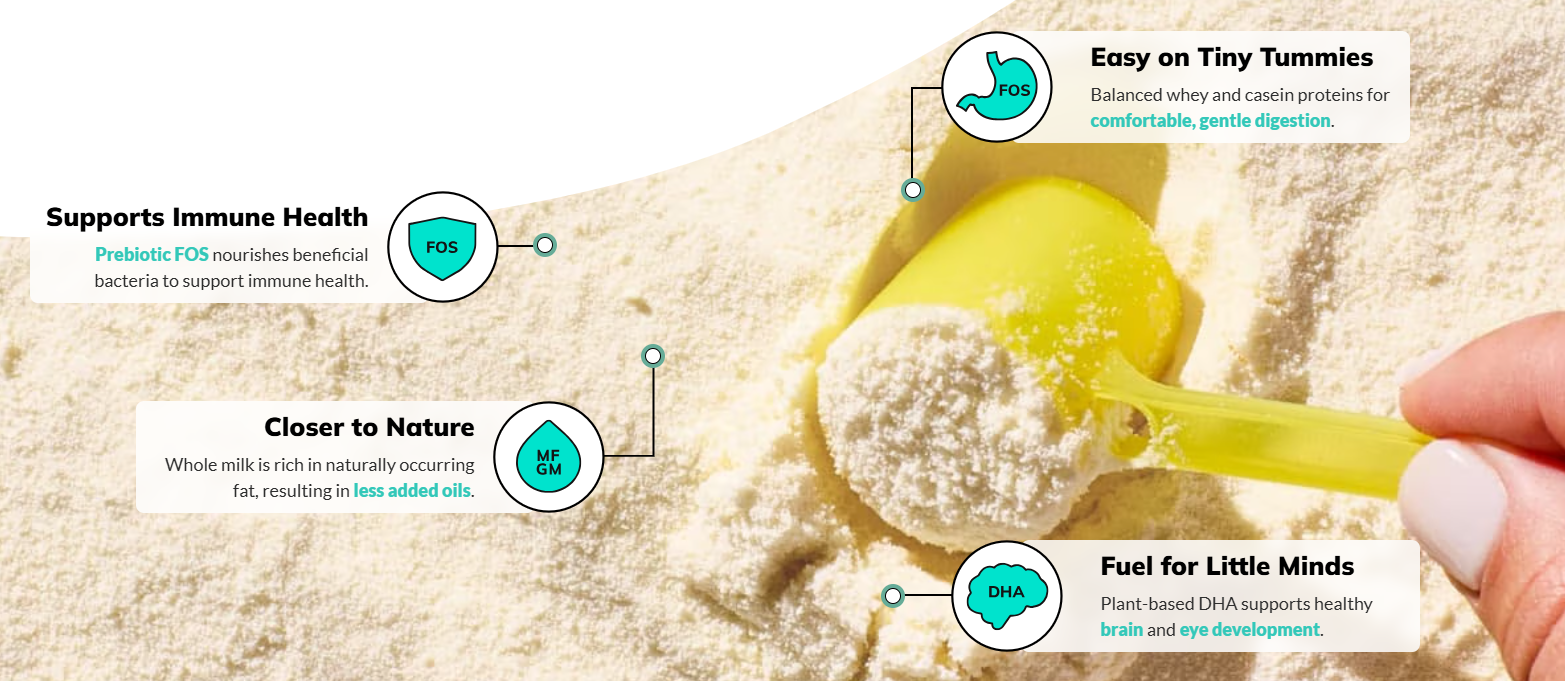
For instance, Little Spoon’s Organic Whole Milk Infant Formula lists all five nucleotides in its ingredient list. I do like that it includes the full set rather than selecting only one or two because it shows that nucleotides were considered as part of the overall recipe. However, I view this as one positive detail, not proof that the formula will improve my baby’s immunity, digestion, or development.
The Role Nucleotides Play in Choosing a Formula

After all the hours spent on research, I’ve decided to put nucleotides in the “nice to have” category. If I had to choose between two formulas that were equally affordable, available, and suitable for my baby, I might lean toward the brand that includes all five. But, I would not switch my baby from a formula that already works well just because another brand had a longer nucleotide list.
As parents, we already have enough to worry about, and feeling like we’re making the wrong choice because one optional ingredient is missing just isn’t right. A formula without nucleotides can still provide complete nutrition.
Pay more attention to whether your baby tolerates the formula, the formula’s availability is consistent, it fits your budget, and the brand is transparent about its ingredients and testing. These details have a much bigger effect on the choice you make when it comes to formula than the presence or absence of nucleotides.
This is where my attitude has changed since choosing formula for my first son. Back then, I viewed every extra ingredient as something my baby absolutely needed. Now, I look at the full picture. An ingredient can be useful without being essential, and it can be included for a valid reason without delivering every benefit suggested by marketing buzz words.
A Thoughtful Extra, Not an Essential
Yes, babies need nucleotides for normal growth and cell function, but healthy babies don’t need them added to formula. Their bodies can naturally produce them, and current regulations do not require them.
Many formula brands add nucleotides to their formulas because they are naturally present in breast milk and may support the developing gut and immune system. In my opinion, nucleotides are a thoughtful bonus, not a must have. I’m happy to see them on an ingredient list, but I wouldn’t reject a good formula because they weren’t there. At the end of the day, the best formula is one that safely feeds your baby, works for your family, and doesn’t turn every feeding into a bottle of stress.