
If you hang out in parenting forums, you may hear that European formula is better, and that if you’re using American formula, you’re just settling. On the other hand, your pediatrician tells you that US formula is fine. Both claims sound reasonable, leaving you not knowing what to do.
We all want the absolute best for our babies and want the honest version. The truth is, European and US formulas do differ, including how they’re regulated. But how do you tell the difference between the truth and internet folklore?
This guide will answer that question for you, showing you what each system actually requires—the rules, carbohydrates, iron, DHA, and organic labels—allowing you to choose what is important for your baby instead of taking an internet stranger’s word for it.
Table of Contents
European vs US Baby Formula at a Glance
| European Union | United States | |
| Who Sets the Rules | European Commission (Regulation 2016/127) | FDA (21 CFR 107.100) |
| Carbohydrate Rules | Only approved carbohydrate sources; lactose must be at least 4.5 g per 100 kcal in standard formulas | No rules on carbohydrate source; no lactose minimum |
| Iron | 0.3–1.3 mg per 100 kcal for first-stage formula | 0.15–3.0 mg per 100 kcal, one range for the whole first year |
| DHA | Required: 20–50 mg per 100 kcal | Optional, though most brands add it (a new FDA proposal may change this) |
| Organic Certification | EU organic leaf, under European Commission rules | USDA Certified Organic, under the National Organic Program |
| Age Stages | Stage 1 (0–6 months) and Stage 2 (6–12 months) | One formula for the full first year |
Who Writes the Rules?

It may surprise you that infant formula is one of the most tightly regulated foods in the United States. As an example, under the Infant Formula Act, the FDA has established minimum levels for about 30 nutrients, in addition to maximum levels for nine.
In the United States, the same formula is used for the entire first year of a baby’s life and must provide complete nutrition. Before it can go to market, the manufacturers of a new formula must alert the FDA, and quality-control and recall rules are strict and apply to every batch, whether it’s from a decades-old name or a newer brand like Little Spoon. There is no such thing as an unregulated American formula, even if you’ve heard otherwise.
In Europe, rules about baby formula come from the European Commission (EU), and they are a bit stricter about composition. They set maximums and minimums for nearly every nutrient in a European formula like Kendamil. They also restrict certain ingredients that the US does not address and require some things the FDA calls optional. The EU even oversees marketing. They do not allow pictures of babies on formula labels and have other rules that limit how these products can be advertised.
So, you can see there are differences between how Europe and the United States regulate baby formula. However, those differences may be becoming fewer. On November 2, 2026, a major update to formula nutrient standards was proposed by the FDA, the first major update in 30 years. This proposal makes several vitamin and mineral levels stricter, and the FDA is considering public comment on requirements for DHA and ARA, as well as whether iron levels should change.
The Nutrient Rules That Actually Differ

Carbohydrates: The Biggest Real Difference
The argument that European formula is better usually centers on carbohydrates. This is where the argument has its strongest footing.
The EU allows only a short list of carbohydrate sources in formula and requires lactose, the sugar found in both breast milk and cow’s milk, to be the primary carbohydrate, accounting for at least 4.5 grams per 100 kcal of standard milk-based formula. Sucrose is allowed in limited amounts in certain hydrolyzed formulas.
The FDA differs in that it sets requirements for the total carbohydrate energy a formula provides but has no rules about where the carbohydrates come from. This explains why corn-syrup solids and maltodextrin are legal in US formulas but rarely found in European ones. These carbohydrates have a viable role in formulas for babies who can’t tolerate lactose. However, in a standard formula, they are usually there for cost, not to improve nutrition.
To sum it up, if you need a lactose-based formula, you don’t need to import anything from Europe. Several US-sold formulas use lactose as the primary carbohydrate, right in line with what EU rules require. Read the ingredient list. One nice thing that European labels do is carry a lactose-only statement when lactose is truly the sole carbohydrate in the can, and this is legally enforced.
Iron: Two Philosophies, Not One Right Answer
There are different philosophies regarding iron between the United States and Europe. EU rules allow 0.3 to 1.3 milligrams per 100 kcals for the first six months, with a higher range after six months. The US allows 0.15 to 3.0 milligrams per 100 kcals during the entire first year, with most US formulas having more iron than the European ones.
The basis for this difference is iron-deficiency anemia, which the 2026 American Academy of Pediatrics (AAP) guidelines treat as a major developmental risk, not a minor oversight. Untreated iron deficiency can disturb brain growth and cognition, which has led to earlier screening, universal iron supplementation for at-risk infants, and stricter dietary limits on milk intake.
On the other hand, European regulators believe in iron levels closer to breast milk for the first six months, then staged formulas to raise iron after. Babies tend to do well under both systems. However, the FDA is firm about iron levels and has recalled imported European formulas that contain less iron than US rules require without displaying it on their labels.
So, what are you to do with this information? You should feel comfortable if you’re feeding your baby a US formula because there’s no need to supplement with iron, and you definitely shouldn’t without talking to your pediatrician. If, on the other hand, you’re attracted to European-style iron levels, that’s another reason to discuss with your doctor, not a decision you should make on your own.
DHA: Required There, Optional Here (for Now)
Beginning in 2020, the EU has required every formula to contain DHA, an Omega-3 fatty acid important in brain and eye development. They require 20 to 50 milligrams per 100 kcals. In the US, DHA is optional, though most major brands include it anyway, usually paired with ARA, an omega-6 fatty acid that the EU doesn’t require at all.
Despite the different requirements, you may find American formulas with more of the brain-development duo than European ones. The FDA’s new proposal asks whether both should become mandatory, so this difference may change in the near future.
Organic Certification: Two Logos, One Idea

The US and Europe use different labels to indicate organic certification, but they essentially mean the same thing. In the US, the label says USDA Certified Organic, while Europe uses a green leaf logo. Both mean ingredients cannot be grown with prohibited synthetic pesticides, fertilizers, or GMOs. Each country has certain pasture and welfare requirements that dairy animals must meet. There is a long-standing US–EU arrangement wherein the two systems recognize each other for trade purposes.
It’s easy to understand, though it can get a bit confusing for parents. For any food product, people often think organic certification is a great thing without even understanding what it means. In reality, organic certification is only about farming and sourcing, not contaminant testing or nutrition. So, a product can be organically certified but still follow its own region’s nutrient requirements. Therefore, the differences in iron, carbohydrates, and DHA don’t disappear just because there’s a seal or leaf on the can.
Also, neither country requires a brand to test the finished formula for heavy metals or publish the results. The term “organic” only means one thing, and that’s about farming and sourcing. If a brand wants to test for heavy metals, for example, it has to do that itself and publish the results to show parents what’s actually in the finished can. And no regulation in either country requires that.
Two Formulas That Show Both Sides
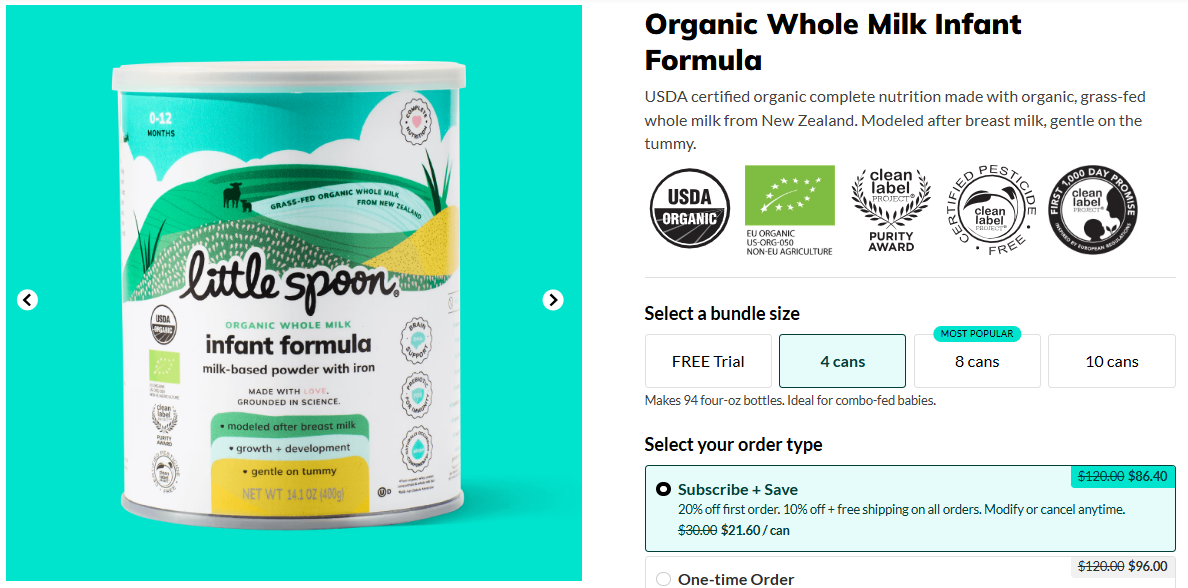
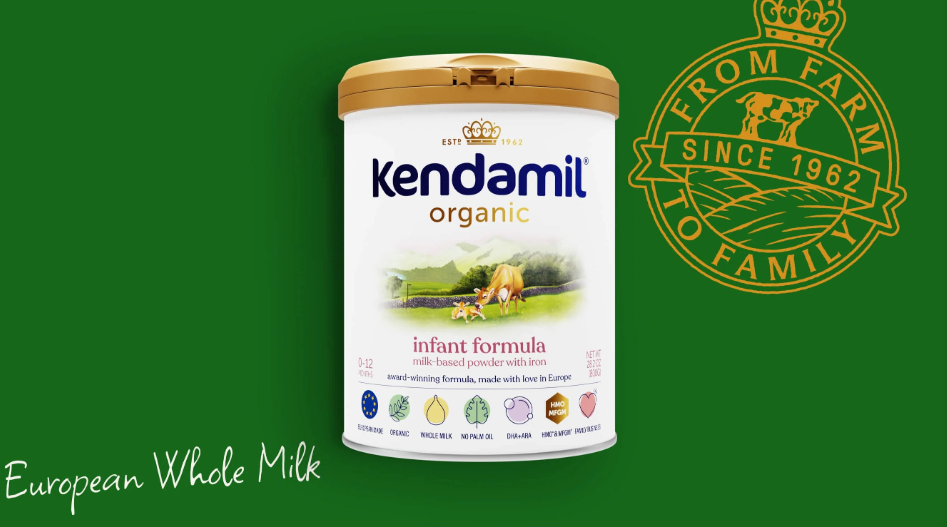
An easy way to see these differences in practice is to put one can from each system side by side. Little Spoon’s Organic Whole Milk Infant Formula is an American formula, made for the US market under full FDA oversight. Kendamil Organic is a European recipe made in the UK, sold in the US as an FDA-reviewed version at major retailers, with no gray-market shipping involved. Both are organic, whole-milk, lactose-based formulas, which tells you how much the two systems now overlap.
| Little Spoon Organic Whole Milk | Kendamil Organic | |
| Made With | Organic grass-fed whole milk from New Zealand | Organic whole milk from European grass-fed cows |
| Main Carbohydrate | Organic lactose (first ingredient) | Lactose |
| DHA and ARA | Both included | Both included (plant-based DHA) |
| Organic Certification | USDA Certified Organic | EU Organic, with USDA-certified organic milk and lactose |
| Regulation | FDA regulated, made in the US | European recipe; FDA-reviewed US version |
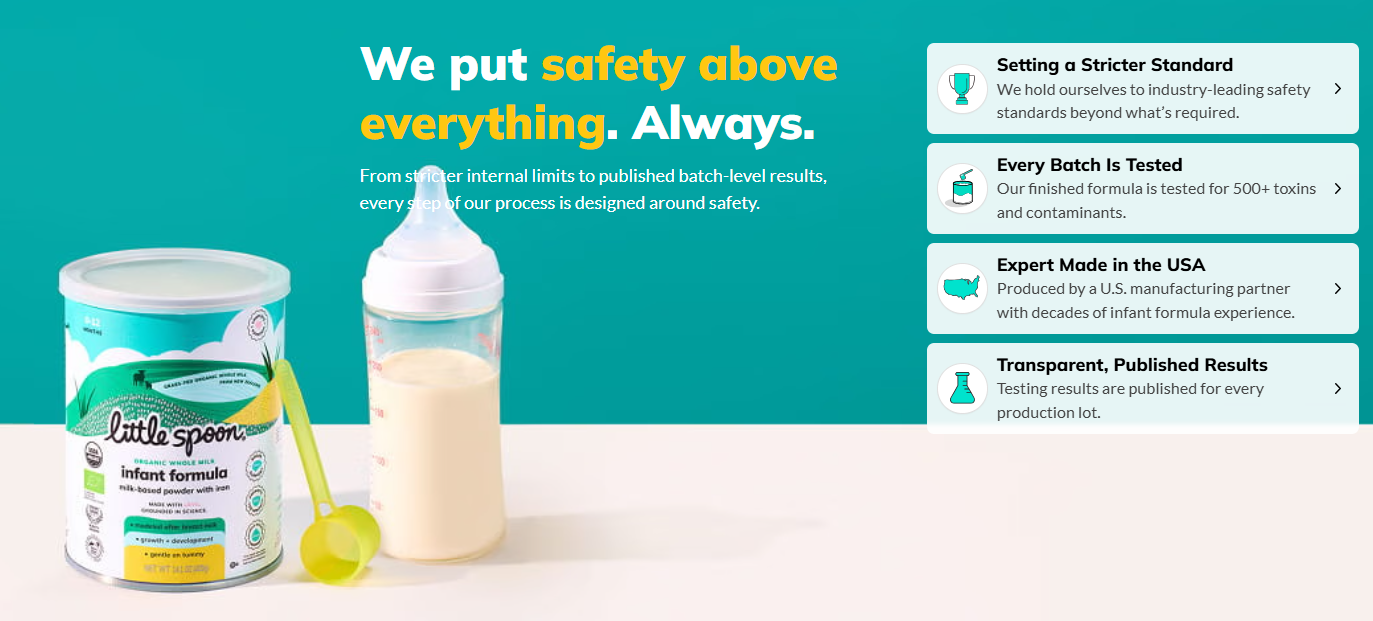
| Batch Test Results | Published for every batch (500+ toxins, six categories); specific numerical results published online | Every batch tested; generic “pass/fail” results published online |
Neither can is the imported European formula parents used to hunt for, and that’s the point. Both give you European-style ingredients with the FDA review and recall system intact.
The Real Problem with Imported European Formula
So, is it okay to feed your baby a European formula? The answer is that both formulas are well regulated, and there’s nothing wrong with the formula itself. However, there can be concerns about what happens between the factory and your kitchen.
- No FDA oversight. Formula brought in by third-party vendors skips FDA review entirely. A 2019 study in the Journal of Pediatric Gastroenterology and Nutrition examined 16 imported European formulas and found that not one met all FDA labeling requirements.
- Recall blind spots. If a formula is recalled in Europe, the news can be slow to reach US buyers. In 2021, roughly 76,000 units of imported European formula were recalled in the US, in part over iron labeling.
- Mixing confusion. Many European formulas mix one scoop per ounce of water; most US formulas mix one scoop per two ounces. Instructions may not be in English. Mixing errors in young infants can cause serious harm.
- Shipping and storage unknowns. Powder that sat in a hot shipping container can lose nutritional value, and nobody along the gray-market route is checking.
- Stage mix-ups. European formulas come in age stages. Buy the wrong one, and your baby may get nutrient levels meant for a different age.
- Words that don’t mean the same thing. A European “HA” (hypoallergenic) formula is defined differently than a US hypoallergenic formula, so a baby with a true cow’s milk protein allergy may not improve on one. This is a detail that’s easy to miss when the label isn’t in English.
For these reasons, the AAP discourages feeding your baby imported formulas bought through third-party sellers. The exception is some European brands like Kendamil, which make FDA-reviewed versions sold through ordinary US retailers. That’s entirely a legitimate option.
The Good News: You No Longer Have to Choose
It’s understandable that parents who wanted a lactose-free, organic, whole-milk formula used to feel they had to get it from Europe. However, the same qualities that used to make parents more satisfied with European formula now exist in the US market, with FDA oversight and the American recall safety net intact.
Little Spoon‘s infant formula is a good example of how far the progression has come in the US. It’s USDA Certified Organic, uses lactose as its main carbohydrate, and starts with grass-fed whole milk from pasture-raised New Zealand cows. They also offer more transparency than either the US or European regulators require: They publish their own contaminant limits and batch-specific, numerical testing results.
Kendamil’s US-sold organic formula is another contender, but note their publishing of test results is simply “pass/fail.” If the transparency angle is less important to you than the formula’s components, it’s a viable option.
It’s always a good idea to let your pediatrician know what formula you’re considering. They know your baby better than any regulation does. Also, try to relax a bit. You’re obviously doing a good job, considering you’re researching what’s best for your baby. Formulas for both continents produce thriving babies every single day. The smartest move isn’t about picking a continent. It’s more about selecting a formula that’s legally sold here. That way, every protection the US system offers is working for your child.